
Why Chemical Bonds Glow Without Any Heat
Chemiluminescence explained visually: how a reaction leaves electrons in an excited state, and why they give that energy back as light instead of heat.
Selected from the official eduvids YouTube channel and presented here as an example of the product's output.
Transcript
If you snap a glow stick, it shines bright neon, yet the plastic stays completely cold. We usually expect things that glow to burn hot, like the wire inside a toaster. Instead, this cold glow comes from something far quieter hidden inside chemical bonds. Picture two single atoms drifting toward each other in empty space.
Neither atom carries a hard shell, just a fuzzy cloud of vibrating electrons. As they meet, those two clouds do not bounce away. They blend into one shared pool. That merged cloud pulls both nuclei inward, locking them into a stable chemical bond.
Inside this shared space, electrons cannot wander wherever they please. Quantum rules force them onto strict energy rungs like steps on an invisible ladder. Normally, electrons settle comfortably on the lowest possible step in the ground state. When incoming energy kicks the molecule, an electron leaps up to a higher rung.
It bounces up there in an excited state, but only for a tiny fraction of a second. When it drops back down, that lost energy has to escape somewhere. It bursts outward as a single packet of light called a photon. Here is the puzzle.
Because the outgoing light looks completely different from what went in. Shine invisible UV light onto a fluorescent dye and it answers with vivid green. Before the electron drops all the way home, the chemical bond flexes and wiggles. That gentle vibration steals a small sip of energy, stretching the wave into visible colors.
Sometimes an electron flips its magnetic spin and gets stuck on a forbidden shelf. Trapped with nowhere to go, it can take minutes or hours to finally tumble down. That slow trickle of delayed photons is why glow-in-the-dark toys linger all night. This entire dance unfolds without raising the temperature of a molecule by even a single degree.
Cold light is simply the rhythm of electrons falling down molecular stairs. Continue with our previous video. Why overlapping events break naive edition. The link is in the description and top comment.
More visual explanations
 Video
VideoWhy Carbon Builds All of Organic Chemistry
See how carbon’s four valence electrons let it form stable chains, rings and double bonds, the backbone behind every molecule in organic chemistry.
 Video
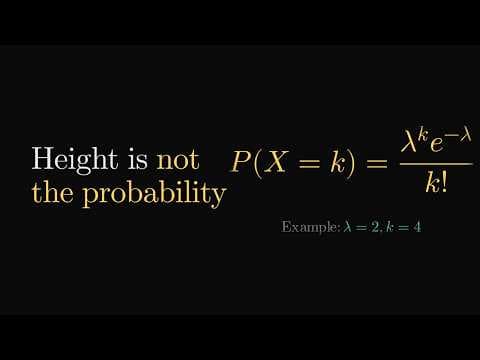
VideoWhy the Area Under a Curve Equals 1
Why every probability density curve encloses an area of exactly 1, and how area under the curve becomes probability for a continuous random variable.
 Video
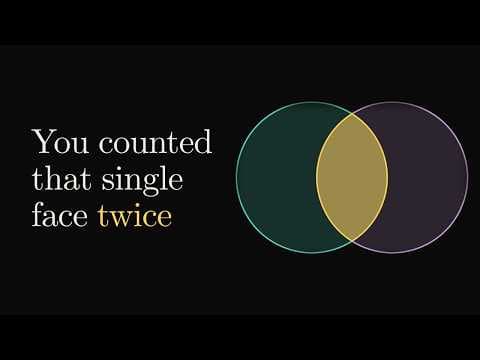
VideoWhy Overlapping Events Break Naive Addition
Why P(A or B) is not simply P(A) + P(B) when events overlap, and how the inclusion–exclusion principle removes the outcomes counted twice.